


Market data as of the close on Friday, November 20, 2026
Stocks had one of their roughest weeks in years, with the S&P 500 falling 8.6% and the Nasdaq dropping nearly 10%. Bonds did their job as a cushion: Treasury yields fell sharply and the broad bond market gained 1.2%. Below we walk through what happened, what the economic data is telling us, and how we are thinking about it.
What drove the decline
The selloff centered on artificial intelligence stocks, which have driven much of the market’s gains, and its swings, in recent years. Several worries piled up at once:
- Leadership shock: The sudden resignation of Nvidia’s CEO, one of the industry’s most prominent figures, unsettled investors in AI-related companies.
- New trade limits: The administration issued a new rule restricting China’s access to the most advanced AI chips.
- Valuation doubts: Investors questioned whether heavy spending on data centers will produce enough profit to justify today’s prices.
- Higher interest rates: Markets increasingly expect another Federal Reserve rate increase in December, which raises borrowing costs for fast-growing companies.
Even strong demand for a high-profile AI company’s stock market debut on Thursday could not stop the slide. By Thursday’s close, the S&P 500 had fallen six days in a row, its longest losing streak in about two and a half years, and the Nasdaq was more than 10% below its October high, the common definition of a correction.
Stocks: a broad selloff led by technology
The decline was wide, hitting large and small companies and markets at home and abroad. Even after the drop, the S&P 500 is still slightly positive for the year.
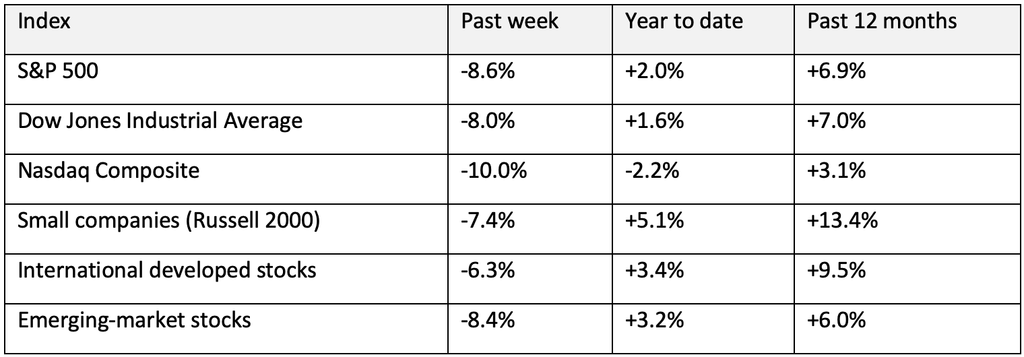
Growth stocks took the hardest hit. Large-company growth stocks fell 11.4% for the week, while large-company value stocks fell 6.2%. That widens an already striking gap this year: large value stocks are up about 19% year to date, while large growth stocks are down about 14%.
Defensive sectors held up best. Technology and communication services led the decline, while consumer staples, utilities and real estate fell the least. For the year, energy remains the standout, up more than 38%.
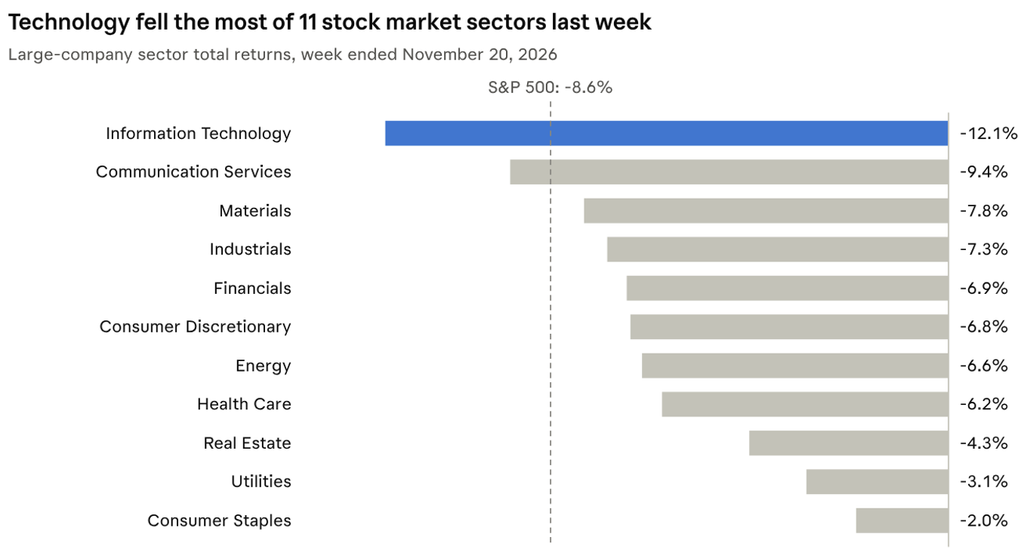
Source: Bloomberg – S&P 500 sector total returns, week ended November 20, 2026
Bonds: high-quality bonds provided ballast
As investors sought safety, Treasury prices rose and yields fell. The 10-year Treasury yield dropped about 0.2 percentage points to roughly 4.9%, and the 2-year yield fell to about 4.6%. The broad investment-grade bond market returned 1.2% for the week, a good reminder of why we hold quality bonds alongside stocks.
Riskier corners of the bond market did not share in the gains. High-yield (“junk”) corporate bonds lost 0.9%, and the extra yield investors demand to hold them over Treasuries widened by about 0.5 percentage points, a typical sign of rising caution. The Federal Reserve’s target rate was unchanged at 4.00%, while the average 30-year fixed mortgage rate rose to about 7.3%.
Commodities, gold, crypto and the dollar
- Gold did not act as a safe haven this time, falling about 9.5% for the week to roughly $3,500 per ounce. It is now down about 19% for the year.
- Bitcoin dropped about 15% and is down roughly 33% year to date, another reminder of how volatile digital assets can be.
- Oil slipped to the mid-$80s per barrel, though it remains well above where it started the year. Broad commodities fell 4.3% but are still up about 20% in 2026.
- The U.S. dollar edged up 0.4% and is up about 5.6% this year.
The economy: steadier than the market’s mood
The economic data stands in contrast to last week’s market drop. The labor market remains solid, and consumers are still spending.
- Jobs: Employers added 165,000 jobs in October, and the unemployment rate dipped to 4.1%. Weekly jobless claims remain low at about 203,000.
- Consumers: Retail sales rose 0.2% in October and are up 6.8% from a year ago. Consumer sentiment improved modestly, though it remains low by historical standards.
- Inflation: Consumer prices were up 3.7% from a year earlier as of September, with core inflation (excluding food and energy) at a more moderate 2.6%. Energy has been a key driver of the gap.
- Business activity: Manufacturing and services surveys both remain in expansion territory.
Relief at the pump. Energy markets have been disrupted this year by the conflict with Iran, and the U.S. has drawn its Strategic Petroleum Reserve down to its lowest level since 1982. The good news for households: the national average price of gasoline has fallen to about $3.72 a gallon, down roughly 18% from its May peak of $4.56. If energy prices keep easing, that should help bring overall inflation down over the coming year.
The week ahead
It is a holiday-shortened week, with U.S. markets closed Thursday for Thanksgiving and closing early on Friday. Lighter trading volume can sometimes amplify price swings. On the calendar are early (“flash”) readings on business activity and new home sales.
Year-end planning: turning volatility into opportunity
With about five weeks left in 2026, a market pullback can create planning opportunities. A few worth reviewing:
- Tax-loss harvesting: In taxable accounts, selling investments below their adjusted cost basis can generate capital losses that may offset capital gains and, to the extent losses exceed gains, up to $3,000 of ordinary income annually ($1,500 if married filing separately), subject to applicable IRS rules. Watch the wash-sale rule, which disallows the loss if you buy the same or a substantially identical investment within 30 days before or after the sale.
- Rebalancing: Stocks fell while bonds rose, and growth and value have moved far apart this year. Portfolios may have drifted from their targets, and rebalancing brings risk back in line with your plan.
- Required minimum distributions: If you are required to take distributions from IRAs or other retirement accounts, most must be completed by December 31 to avoid a penalty.
- Roth conversions: Converting when account values are lower may reduce the taxable conversion amount, with future growth potentially exempt from federal income tax upon qualified withdrawal.
- Charitable giving: Donating appreciated investments, using a donor-advised fund, or making a qualified charitable distribution from an IRA (age 70½ and older) can make your giving more tax-efficient.
Everyone’s situation is different, so talk with us and your tax professional before acting on any of these.
Our perspective
A week like this one is uncomfortable, and it is natural to want to do something. History suggests that reacting to short, sharp declines often does more harm than good, because some of the market’s best days tend to come soon after its worst.
A few things stand out to us:
- Diversification helped mitigate the impact of declines in certain asset classes during this period. Quality bonds rose while stocks fell, and value and defensive stocks declined far less than high-flying growth stocks.
- The economy is not in distress. Hiring, spending and business surveys remain healthy, even as markets reprice.
- Your plan was built for weeks like this. Your allocation reflects your goals, time horizon and comfort with risk, not the headlines of any single week.
If you have questions about your portfolio or how recent volatility affects your plan, please reach out. We are always happy to talk.
Important disclosures
Boulder Wealth Advisors, LLC, is a registered investment adviser. This commentary is for informational and educational purposes only and is not a recommendation to buy or sell any security or to adopt any investment strategy. Opinions expressed are as of the date shown and are subject to change without notice. Information is obtained from sources believed to be reliable, but its accuracy and completeness are not guaranteed. Index returns are shown for illustrative purposes only, do not reflect fees or expenses, and are not available for direct investment. Past performance does not guarantee future results. All investing involves risk, including the possible loss of principal. Diversification does not ensure a profit or protect against loss in a declining market.
Tax-loss harvesting is subject to applicable IRS rules, including the wash-sale rule. Tax benefits vary based on individual circumstances and are not guaranteed. Unused capital losses may generally be carried forward to future tax years. Consult a qualified tax professional regarding your specific circumstances.
Diversification does not guarantee a profit or prevent losses in declining markets. All investments involve risk, including the possible loss of principal.
Roth conversions may result in current income tax liabilities. Qualified Roth IRA withdrawals are generally exempt from federal income tax, subject to applicable IRS requirements, including five-year holding period rules. Tax benefits depend on individual circumstances. Consult a qualified tax professional before implementing a Roth conversion strategy.